Amorphous Magnetic Cores For High Frequency Electronics
![]() |
Amorphous magnetic cores allow smaller, lighter and more energy efficient designs in many high frequency applications for Invertors, UPS, ASD(Adjustable speed drives), and Power supplies (SMPS). Amorphous metals are produced in using a rapid solidification technology where molten metal is cast into thin solid ribbons by cooling at a rate of one million°C/second. Amorphous magnetic metal has high permeability due to no crystalline magnetic anisotropy. Amorphous magnetic cores have superior magnetic characteristics, such as lower core loss, when compared with conventional crystalline magnetic materials. These cores can offer superior design alternative when uses as the core material in the following components: |
AC Reactor DC Reactor PFC boost
inductor: Under 6kW (Mircolite 100m), Over
6kW Common mode chokes
MagAmp Differential mode chokes / SMPS output inductor Spike absorbing cores
| Technical advantage | |
Where typical ferrite cores can only operate up to a flux saturation level (Bsat) of 0.49 Tesla, amorphous metal cores can be operated at 1.56 Tesla. Combined with operating at permeability similar to high-end ferrites and the flexibility of manufacturing large cores sizes these cores can be an ideal solution for many of these components. Nanocrystalline amorphous metal offers size, core and labor savings for various EMC applications. |
|
| Powerlite C-cores | |
![]() |
These amorphous cores wound in a C-core configuration, are ideal for AC Reactors and DC inductors from 10 to 1000+ amperes. The C-core also allows for single phase and three phase transformer designs. |
![]() |
Three phase designs can be done with standard single-phase cores or a custom three-phase core can be constructed in a two-piece set as shown below: Amorphous metal C-cores allow for operation at higher frequencies at the same flux level. Where traditional steel cores need to operate at increasingly lower flux densities as the frequency increases. In order to compensate for running at lower flux densities significantly more material is needed. Even with additional material higher temperatures still occur. Another contributor to lowering losses is the I2R of the winding. A physically smaller amorphous core reduces your mean length per turn, hence your I2R copper losses are lower and copper costs are lower. |
| Winding options | |||||||||||||||||||||||||||||||
For higher current applications these cores open up the new options for the conductor winding process that is not easily achievable for toroidally constructed cores:
In each of the above options, the winding can be accomplished on a separate mandrel and assembled onto the C-core after the winding process. Litz is wire commonly used for high current/high frequency designs. However, terminating litz wire for these applications can be expensive. An alternative to consider is disc or edge winding. This involves winding a rectangular wire that has a relatively high aspect ratio on its edge The quasi-planar structure reduces the skin effect, but not as great as using litz wire although greater than can be realized with similar magnet wire or copper foil. Other advantages are: lower copper loss, reduced DCR, smaller size, improved heat dissipation. Higher wattage switching devices allowing operating frequencies of 10 and 20kHz are now becoming cost effective for the high power designer. In the past traditional EI and UI laminated inductors using 3% Ni, silicon grain oriented steel could be used with little problem. 3 percent nickel, silicon grain oriented steel appears to be dead above 1kHz. Special design considerations that take into account the lower flux densities at these frequencies allow this material to be pushed beyond its normal intended application. This however can result higher temperatures and much larger core sizes than with a comparable amorphous core design. These are summarized in the below chart: |
|||||||||||||||||||||||||||||||
Amorphous cores for high frequency inductors verses competitive materials
|
|||||||||||||||||||||||||||||||
This design assumes50% permeability with 50 Oe of bias, 2500 perm ferrite was used for comparison and core determined at 20 kHz and 2 kg BAC When comparing Iron Powder to Amorphous core. The Amorphous core will tend to be less expensive, and have lower losses, smaller physical size, betterheat dissipation, and are mechanically rugged
|
|||||||||||||||||||||||||||||||
To choose the best core for your design, download following calculators:
|
|||||||||||||||||||||||||||||||
| Magnetization curves: | |
For larger kilowatt power supplies,. High frequency transformers using these C-core offer higher saturation induction of 1.56 Tesla and lower losses allowing for:
|
|
| Powerlite forms | |||
![]() |
We produce rectangular shapes of amorphous metal coresby stacking layers of laminations made from amorphous metal ribbon. An adhesive rated for a continuous operating temperature of 155°C holds the laminations together. These forms offer a unique combination of high saturation induction (1.56 T), high permeability and low core loss and can be configured into various shapes, allowing for one large gap to be distubuted across several smaller gaps, reducing fringing flux, and core loss. |
||
| Possible configurations: | |||
![]() |
|||
![]() |
Hybrids and be designed using c-core sections with corresponding bricks for unique shapes Applications: Medium Frequency and High Power Inverters |
||
| Technical data sheet: (link: Technical Bulletin PDF Format 305k) | |||
| Toroidal Amorphous Cores | ||||||||||||||||
| These are offered in various amorphous metals depending on your application | ||||||||||||||||
|
||||||||||||||||
|
||||||||||||||||
MicroLite® Toroidal Choke Coresfrom Metglas® are manufactured with iron-based Metglas® amorphous Alloy-SA1. They offer a unique combination of high saturation induction, high permabiliity and the lowest core loss available for high frequency choke cores allowing the use os significantly smaller sizes than possible with conventional materials. Applications: |
||||||||||||||||
|
||||||||||||||||
MICROLITE XP products are made of amorphous alloys, which are non-crystalline in nature. Metglas® MICROLITE XP cores operate cooler and have lower core losses than cores made of conventional crystalline materials such as powdered iron, ferrite or sendust. MICROLITE XP's energy-efficient properties reduce the size of powder sources for demanding applications in the electronics industry Applications: |
||||||||||||||||
|
||||||||||||||||
MagnaPerm® High Permeability Cores are manufactured with cobalt-based Metglas amorphous alloy 2714AF for high frequency applications. Theses flat loop toroidalcores offer a unique combiation of ultra-high permeability, high saturation flux density and extremely low core loss for electronic component designers. Applications: |
||||||||||||||||
|
||||||||||||||||
Metglas® Square Loop Coresmanufactured with cobalt-based Metglas® amorphous Alloy 2714A allow the design of mag amps that can operate at higher frequencies than previously possible. Their combination of magnetic properties enable mag amps to provide unparalleled precision and efficiency in output regulation. Applications:
|
||||||||||||||||
|
||||||||||||||||
| Nanocrystalline common mode choke coils and cores | ||
![]() |
Single-phase cores These are toroidal shaped tape-wound cores made from nanocrystalline amorphous metal. Our products offer a superior technical solution for many EMC problems when compared to Mn-Zn ferrite choke. |
|
![]() |
Three-phase cores These advantages are:
Download EMC brochure for information on common mode components: |
|
Sizes offered Standard wound common mode and choke cores are available as standard products for DC and single-phase AC power lines (rated current from 5A to 40A), and for three-phase AC power line (rated current from 3A to 600A). |
||
| Single-phase vertical mount | Single-phase horizontal mount | |
![]() |
![]() |
|
Three-phase wound components Custom designs are available upon request, for your application your can pick the standard product that most closely meets your needs, or fill out our request form for a recommendation. Typical applications include various portions of the power supply / inverter such as input single and three phase noise filters, active harmonic filters, output noise filters, DC Power Lines or Signal Lines. |
||
![]() |
![]() |
|
| Download
EMC brochure for information on common mode components: |
||
| Nanocrystalline Amorphous metal | |
![]() |
Nanocrystalline amorphous metal is produced by rapid quenching a molten alloy to produce a amorphous metal and then heat treating this alloy at higher than its crystallization temperature The alloy forms Nanocrystalline grain size of approximately 10 nm in the amorphous metal.
|
![]() |
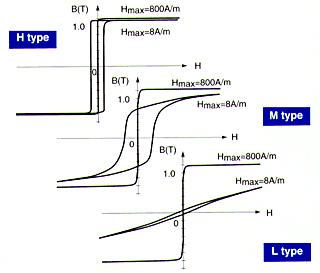
Annealing changes BH loops M type material is done with no magnetic field applied during annealing We produce H and L type BH loops by annealing with magnetic fields oriented either parallel or perpendicular to the ribbons surface. Advantages are:
|
| General Informational Brochure | |
| Surge Absorbers beads and cores | |
![]() |
Our NANO amorphous tape-wound cores are used in (SMPS) Switched-Mode Power Supplies, Frequency Inverters, ASD and UPS and other applications for effective noise suppression caused by rapid changes in current. The high pulse permeability of these cores allow excellent performance in the suppression of reverse recovery current from the diode and ringing or surge current from switching circuit. The Surge Absorber Cores are normally used as single-turn choke or with very few turns The saturation magnetic flux density is twice as high as that of Co-based amorphous metal and three times higher than that of Ni-Zn ferrite. The pulse permeability and the core loss are comparable to Co-based amorphous metal. As a result, a small core made of this material offers higher performance in suppression of surge current and voltage. |
| These cores also feature low core losses and a very high squareness of the BH hysteresis loop resulting in a high inductance when the current crosses zero. This high inductance effectively blocks reverse recovery currents created by diodes. The material saturates at relative small currents. Thus, spike blocking is not possible at DC currents. | |
Toroidal type
bead core |
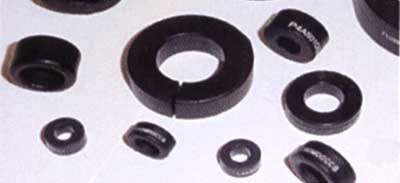
Beads There are two types of beads leaded and non-leaded cores. These are used for low power and excellent performance in suppression of various kinds of current or voltage surge, such as the surge from a switching diode |
Horizontal and vertical mounted leaded cores |
|
| Download EMC brochure for information on beads: | |
| Cores | |
![]() |
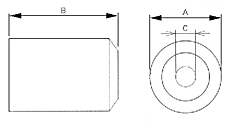
Are used for medium and large power and are toroidally wound cores which show excellent performance for the suppression of various kinds of current or voltage surge, such as a surge from a switching diode. Core range in size from outside diameters of 11 to 38mm and inside diameters of 4 to 22mm. |
![]() |
Download EMC components brochure |
| How amorphous ribbon is made | |
![]() |
|
The casting process Ribbon is cast in widths up to 8 inches in wide and then is slit to width required for winding. Special winding machines wind the ribbon in to various Toroidal, Oval and C-core shapes. Cores then are further process via cutting, coating, annealing according to standard offering and customer requests. Scott drawing from Meeting showing why Metglas is good choose: low losses. |
|
| CT’s | |
For several years now, electronic watt-hour meters have more and more replaced the electromechanical Ferraris counters in the industrial world. Since their advantages are self-evident, it is now foreseeable, that domestic counters will also be substituted by electronic versions within the next decade. The key component of an electronic watt-hour meter is a high-precision current transformer (CT) which isolates the whole device from the mains potential and provides the signal to be counted. By making use of modern high permeability materials like crystalline 80% NiFe of permalloy type (VACOPERM), Fe-based nano-crystalline VITROPERM or Co-based amorphous alloys (VITROVAC), the CT meets the requirements of phase and amplitude-error and linearity according the international meter standards ( e.g. IEC 61036, ANSI C12.xx) with and without DC tolerance in a very easy and economic way. Design support can be given with recommendations for core material, core size, number of |
|